Pond Turtle Study | Presentation of the results
The sessions will include the presentation of the study’s preliminary results and a fieldwork demonstration to bring citizens closer to the use of new technologies applied to conservation.
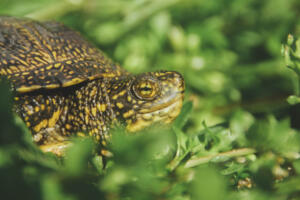
Menorca Preservation and the association Biomediterrània are organising a series of open events to present the preliminary results of a project monitoring the European pond turtle (Emys orbicularis) using drones. This pioneering initiative, developed in Menorca and unique at national level, explores new tools for the study and conservation of this protected species and the wetlands it inhabits.
The events will take place on 12 and 13 June and will combine an informative session with a practical field activity to showcase the potential of new technologies applied to conservation to different audiences.
The first session will take place on Friday 12 June at 6:30 pm at the headquarters of the Institut Menorquí d’Estudis (IME). This event will focus on the project’s technical aspects, presenting the methodology used and the first results obtained. The session is aimed particularly at naturalists, scientists and people interested in conservation.
The following day, Saturday 13 June at 9:00 am, a field activity will be held at Cala Tirant. Participants will have the opportunity to see first-hand how drones are used during monitoring work and to learn more about the study of the European pond turtle and the conservation challenges associated with this species in Menorca. This second event has limited capacity and requires prior registration, which can be completed via the following link: https://tally.so/r/lbY12X. It is designed as an activity open to a broader and family audience.
Nine wetlands monitored: an aerial perspective that could help optimise species monitoring
Over recent months, the team has carried out extensive monitoring work across nine wetlands in Menorca to test this methodology and assess its potential as a conservation tool.
The results obtained point to promising findings and will be shared during the events, where both the methodology used and some of the main conclusions reached so far will be presented.
“After many years of fieldwork with turtles, we have seen that drone monitoring allows us to observe their behaviour much more closely while causing minimal disturbance. This technology clearly has a complementary role alongside traditional methods and makes it possible to obtain very detailed information about the condition of pond turtles and their habitat,” explains Santiago Poch, Field and Data Analysis Technician at Biomediterrània.
Why is it important to protect the European pond turtle?
The European pond turtle is a small freshwater turtle classified as a species of “Special Protection” in the Balearic Islands under Decree 75/2005. It has recently been classified as “Vulnerable” in Spain under the Spanish Catalogue of Threatened Species and is protected under European legislation through its inclusion in the Habitats Directive and the Bern Convention.
Although its population in the Menorca Biosphere Reserve is considered to be in good condition, it still faces threats such as habitat loss, the presence of invasive species, overexploitation of freshwater resources and human pressure.
In addition, it is a bioindicator species: its presence reflects the good health of wetlands. As it requires a well-preserved habitat to survive, ensuring its protection benefits many other species as well.
The importance of safeguarding wetland health
Wetlands, such as streams, ponds and lagoons, are among the most threatened ecosystems globally. They provide a vast range of ecosystem services for people, including the supply of freshwater and their role as climate refuges. Nevertheless, their value and the reasons for protecting them go far beyond this, as they shape landscapes and ways of life around which human societies have adapted for millennia.
As a consequence of their degradation and disappearance, the species associated with these habitats are experiencing significant declines and, in some cases, are disappearing altogether. For this reason, conservation and restoration actions are becoming increasingly urgent. Such actions depend on a clear understanding of the needs of species and habitats, as well as the status of the populations that occupy them — a task that is often physically and financially demanding.