Meet the Grantee | David Blanco
Since 2021, Menorca Preservation has supported Learning through surfing, a programme that invites young people to experience the sea in a different way — not just as a place to visit, but as an environment to understand, respect and feel part of.
We spoke with David Blanco, the project’s coordinator, about the role of surfing in education, and how these experiences can help shape a more conscious and connected relationship with the marine environment.
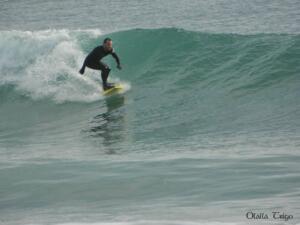
David, how did this project come about and what personally motivated you to set it up?
Learning through surfing is the result of an approach that prioritises collaboration between different people who lead and represent organisations such as Fesurfing, Surf and Clean, Menorca Preservation, the Island Council, Paddle Tour Menorca, Surf and Sail Menorca, as well as schools and secondary education centres. We see teachers and surf instructors as key allies, as we have always been committed to training “agents of change”, given that the task we aim to support — protecting the sea — is far too vast and important to tackle alone.
The idea was originally proposed by Nacho García, Head of Training at Fesurfing, but it was mainly driven by Surf and Clean, the association I lead. Its collaborative spirit goes back much further and is present in earlier personal projects such as the music group Surf and Sun or the cultural association El Cielo Lokal.
Personally, I came to the conclusion that a surfing society gives itself a better opportunity to connect with the marine environment in a deep and meaningful way. There are many historical examples of ocean-based or coastal societies that demonstrate this.
When working with students, what kind of relationship do you observe they develop with their environment? Would you say it differs from that of students in other regions? What similarities do you find?
Most societies today relate to the beach as a holiday destination — a place to relax and disconnect. An idyllic setting to visit, but only at certain times of the year and within very specific patterns of use.
Few people visit it reflecting on its age, aware that these are natural environments whose sandy shores can take up to 20,000 years to form. Spaces that we must share with other living beings essential to the ecosystem, such as Posidonia oceanica, whose presence on beaches is still often seen as a problem for tourism. Few people truly understand the value of dunes, waves or the submerged part of the beach, and the therapeutic opportunities that its waters, air and sand offer throughout the year.
Our role is to share this vision of the sea and the coastline with schoolchildren in Menorca. The main difference is that they start from the advantage of living in a privileged environment and, if they learn to value it, they will also learn to defend it.
The main similarity is that if you ask students from other regions to describe an idyllic place by the sea where they would like to live, they would probably describe a landscape very similar to Menorca.
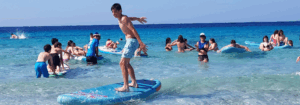
Since the project began in 2021, what changes would you highlight in both students and teachers?
Since we first introduced this project to students and teachers in Menorca, we have consistently observed a strong level of interest. After six seasons, we can confidently say that surfing and its values resonate with the island’s educational community. Over this time, we have grown organically, understanding our capacity and working to establish long-term relationships that offer students a gradual learning process, while giving surf schools the opportunity to pass on their knowledge to local young people. In many schools, Learning through surfing has become an attractive, recurring and necessary programme.
At first, visits to the beach were seen more as an end-of-year activity, but gradually there has been a growing appreciation of the opportunity to carry out these activities on non-urban beaches in early May, when the sea is still active, the water is cool, and the experience feels more authentic. Creating this context has allowed us to reinforce values that are already addressed in schools, but not always internalised in the same way. In this way, we work alongside teachers to achieve a shared goal: to help students fall in love with the sea and its coastline, and inspire them to learn how to protect it.
More than 1,600 children have already taken part in the programme, with students with physical and cognitive diversity included in recent years. What does this progress mean to you and what excites you most about this achievement?
We have always maintained that the essence of surfing is playing in the sea — and ideally with its waves. Many other animals do this, and we likely learned it by observing them. Waves have a powerful magnetism and offer a special connection with the present moment and the environment. However, their size and force, or a lack of understanding of how waves break, can sometimes be intimidating.
Showing students that there are sea conditions suited to each individual’s personality and needs, and that there are also different types of surfing — with or without waves — for everyone, reflects our commitment to promoting a universal form of surfing. The fact that a more diverse range of students now has access to this practice truly demonstrates this, and it is something we are very proud of.
Finally, if you could look ahead to 2030, how would you like to see the programme evolve? What impact would you hope it has achieved?
The ideal future I envision is a Menorcan society capable of building a year-round relationship with the sea, moving beyond seasonality and enjoying it throughout the year. A future in which surfing is part of the school curriculum, as an activity rooted in coastal and island life, offering from an early age the opportunity to rediscover our environment and to build a different relationship with it — one in which we see ourselves as part of a wonderful and complex ecosystem, and never above it.