Migratory birds campaing | First results
More than two thousand birds captured during the first 20 days of the migration ringing campaign on the Illa de l’Aire
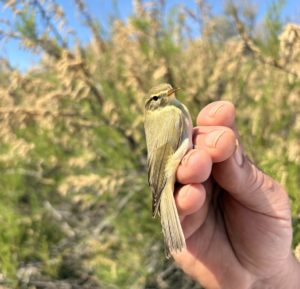
Pre-Saharan migratory species, such as robins and common chiffchaffs, are consolidating themselves as the main protagonists of this first period of the campaign
On 22 March, a new migratory bird ringing campaign began for the Study of pre-nuptial migration on the Illa de l’Aire, carried out by the Societat Ornitològica de Menorca (SOM), with funding from Menorca Preservation.
This campaign forms part of the Piccole Isole (small islands) study, framed within an international project launched in Italy in the late 1980s. Its name reflects its main objective: to understand the importance of small Mediterranean islands as key areas for rest and recovery for migrating birds. In this sense, having well-preserved islets with available food is essential for these birds to replenish their energy and successfully continue their journey.
Thus, over the coming days, ringers and volunteers will take turns to continuously cover the 168 metres of Japanese mist nets set up at the station to record and ring the birds captured using this method. The study, which has been carried out since 1995 at the same time of year and with a consistent methodology, has allowed more than 100,000 birds from around 120 species to be ringed over these 30 years.
The Illa de l’Aire station has become a benchmark in the ornithological field, generating great interest among those wishing to undertake ringing training. To accommodate this interest, the campaign has been extended to 20 days, with the aim of hosting the high number of registered volunteer ringers, coming from both Spain and other countries.
1 – 20 April | Comparison of historical results
Although the campaign began on 22 March, in order to compare this year’s results with previous years, the data analysed correspond to the dates common to all campaign years, that is, from 1 April to 15 May. In these first 20 days of the “official” campaign, a total of 2,254 individuals from 44 different species have been ringed (2,828 from 54 species if we include the ringing carried out during the extra 10 days in March), one of the best records in the historical series. Particularly noteworthy are the ringings of pre-Saharan migrants, especially 265 robins (Erithacus rubecula) and 346 common chiffchaffs (Phylloscopus collybita). Other species ringed in notable numbers include the Sardinian warbler (Curruca melanocephala) and hoopoes (Upupa epops), with 33 records each.
Recoveries of birds ringed abroad
Recoveries of birds ringed abroad have already exceeded the figures for the same period last year. Among them are a common chiffchaff (Phylloscopus collybita) ringed in Sweden, a willow warbler (Phylloscopus trochilus) from Belgium, and a Eurasian blackcap (Sylvia atricapilla) from Austria.
Also noteworthy are the captures of trans-Saharan migratory species, such as the willow warbler (Phylloscopus trochilus) and the common redstart (Phoenicurus phoenicurus), the two most abundant species during pre-nuptial migration, with numbers exceeding the project’s historical average.
The campaign coordinator, Raül Escandell, highlights: “in addition to the high number of captures, the ringing of several uncommon birds during their passage through the Illa de l’Aire, such as the Marmora’s warbler (Curruca sarda) and the eastern species of Subalpine warbler, both with more eastern distribution areas and migratory routes. A Dartford warbler (Curruca hortensis) and a Western olivaceous warbler (Iduna opaca) have also been ringed, species that are uncommon along the Balearic migratory route.”
Impact of the Tramontana in the first days of the stay
The episode of very intense Tramontana winds between 26 March and 3 April, with gusts of up to 145 km/h, completely halted migration over the island. During those days, virtually no birds arrived, confirming the strong effect of the wind on their routes. The impossibility of opening the nets regularly coincided with the visible absence of birds, reinforcing the idea that migration came to a standstill not only on the island but across the entire area. Subsequent data have confirmed that the birds must have remained held up in North Africa, with 452 ringings recorded on 4 April and 203 on 5 April. In addition, the ringed individuals showed high levels of fat and weight, indicating that they had been feeding and waiting for the right moment to resume migration.
Finally, Rebecca Morris, Director of Menorca Preservation, explains that “we know that the Illa de l’Aire is an exceptional enclave, with unique and highly valuable biodiversity, and data such as those being collected by SOM ornithologists are proof of this. Therefore, since 2018 we have supported essential studies, which allow us to better understand the conservation status of its natural values and the role played by the islet for these species, in order to be more effective in identifying impacts and promoting measures that improve its management.”
Collaborating entities:
This year’s ringing campaign is funded by Menorca Preservation and IME-OBSAM, with the support of the Sant Lluís Town Council and the collaboration of MERAK Diving, in terms of transport, as well as the invaluable collaboration of the Autoritat Portuària de Balears.