We bring Posidonia into Menorca’s classrooms
OBSAM-IME brings Posidonia oceanica into classrooms to connect young people with this protected species
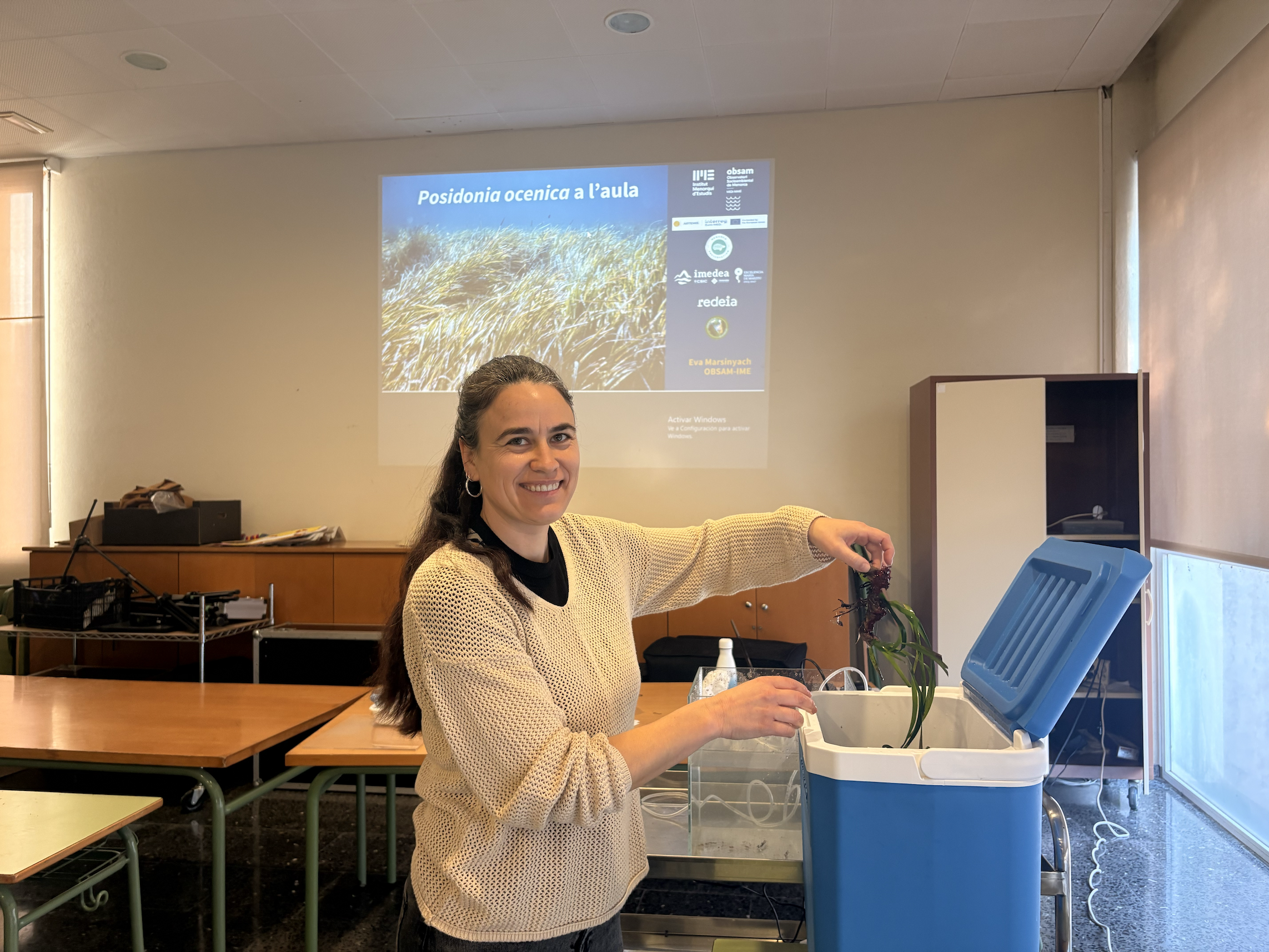
The initiative “Posidonia a l’aula,” which has been running for more than 10 years in over 35 educational centres across Mallorca, is being introduced this year in Menorca thanks to OBSAM-IME, within the framework of the Interreg ARTEMIS project and with the support of Menorca Preservation
OBSAM-IME has brought Posidonia oceanica to 171 students from the CEIP Àngel Ruiz i Pablo in Es Castell and IES Biel Martí in Ferreries through the installation of aquariums containing fragments of this protected species. The activity is part of the “Posidonia a l’aula” project, which in turn forms part of the Bosque Marino de Pollença project, funded by REDEIA. The pilot initiative developed this school year in Menorca is also supported by Menorca Preservation and has been incorporated as an outreach activity within the framework of the Interreg ARTEMIS project.
“Posidonia a l’aula” invites students to actively participate in setting up and monitoring the aquariums throughout the school year. This tool, accompanied by teaching materials provided by OBSAM-IME, will allow them to discover the great diversity of fauna hosted by this marine plant through scientific observation activities, thereby deepening their knowledge of marine ecology.
The aim of this environmental education initiative is, on the one hand, to raise awareness of the importance of Posidonia oceanica meadows in our coastal ecosystems and, on the other, to promote learning about the marine environment in a dynamic and engaging way, encouraging critical thinking, research and scientific vocation among young people.
Eva Marsinyach, research technician at OBSAM-IME, states: “At OBSAM-IME we are very pleased to promote in Menorca this first experience of ‘Posidonia a l’aula’, in which 171 students from one primary and one secondary school are currently participating during the 2025/2026 school year. This pilot allows us to assess the feasibility of the project on the island, both from a pedagogical and organisational point of view, supporting schools and adapting the proposal to the Menorcan context. Our aim is for this experience to serve as a basis for offering the project to more educational centres in the coming years.”
The implementation of the initiative in Menorca has been supported by Inés Castejón, researcher at IMEDEA, and by Xavier Morell and Ferran Morell, teachers from the CAIB and creators of Posidonia a l’aula, who have trained OBSAM-IME staff and provide pedagogical and scientific support throughout the school year. In addition, REDEIA has funded the aquariums and their components for the Menorca pilot.
The teaching staff of the Biology and Geology Department at IES Biel Martí state that: “this ‘Posidonia in the classroom’ project is a very enriching tool for students, as it has allowed them to engage with the reality of the marine environment in a meaningful and experiential way. One of the most notable aspects of the project has been its ability to spark interest and motivation to learn about the organisms that live in it. Through observation, experimentation and research, students have taken an active role in the learning process, developing skills associated with scientific thinking and curiosity to understand the world around them. In short, it is a very positive educational experience that has helped to spark curiosity and foster respect for the marine environment and its conservation.”
Fira de la Ciència i de la Tècnica
The project will be presented to the public at the 5th Menorca Science and Technology Fair under the title “Posidonia in the classroom and habitat-forming species”, which will take place next Saturday 28 and will be open to schools for three days, 30 and 31 March and 1 April at Espai Menorca (former Maó Exhibition Centre). During the event, the OBSAM-IME technical team will share a stand with students from IES Biel Martí to present the project, showcasing first-hand the work carried out with the aquariums and the observation of fauna associated with Posidonia oceanica.
This open space will help bring the project closer to the public and highlight the role of environmental education and citizen science in the conservation of the marine environment.
Rebecca Morris, Director of Menorca Preservation, highlights that: “At Menorca Preservation we believe that education is power, and for this reason we are very happy to have contributed to bringing Posidonia oceanica into classrooms. We believe that strengthening young people’s connection with Menorca’s nature is essential to continue protecting the island and, without a doubt, hands-on experience and direct contact with the environment are among the most powerful ways to connect with its extraordinary natural heritage.”
Posidonia oceanica: a window into the marine world
Posidonia oceanica is a marine plant endemic to the Mediterranean whose conservation status has recently been strengthened by the Spanish Government through Royal Decree 191/2026 of 11 March, which establishes measures to reduce and eliminate the main pressures affecting marine meadows, regulating boat anchoring and promoting low-impact mooring systems, as well as improving scientific knowledge, monitoring its conservation status and restoring degraded areas.
With around 82 km² of meadows around its coastline, Menorca hosts approximately 14% of all Posidonia oceanica surface area in the Balearic Islands (600 km²) and around 0.7% at national level (11,000 km²). In Menorca alone, these meadows contribute to the absorption of approximately 14,860 tonnes of CO₂ per year.
Its underwater forests act as true shields against storm impacts, reducing wave energy. In addition, the dead leaves that accumulate along the coast form structures parallel to the shoreline that act as “natural barriers”, helping to slow coastal erosion.
The Posidonia oceanica fragments used in classrooms have been recovered from the seabed after being naturally broken off during winter storms. Those not suitable for replanting in Cala Blanca have been used for this purpose. OBSAM-IME holds authorisation to allocate these fragments to this educational activity. Once the project is completed, all materials and fragments will be returned to OBSAM-IME.
Background of Posidonia a l’aula
The project began in 2015 as a pilot experience at the Gabriel Comas i Ribas school in Esporles (Mallorca), together with IMEDEA. It forms part of the activities developed within the Bosque Marino de Pollença project, funded by REDEIA. The initiative was highly successful and ensured its continuation in subsequent school years. It is currently part of the training offer of CEP Calvià. In this way, Posidonia a l’aula offers primary and secondary schools the opportunity to work with a top-level educational tool.