Restoration of 1,800 m² of Posidonia seagrass meadow in Cala Blanca (Menorca) completed
©TECNOAMBIENTE
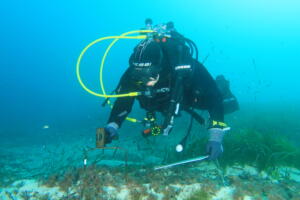
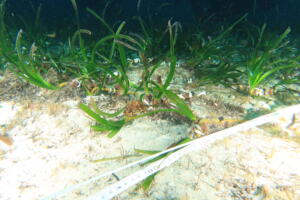
Last Friday, restoration works were completed on 1,800 m² of the Posidonia oceanica seagrass meadow located off the coast of Cala Blanca (Menorca island), which had been affected 15 years ago by a bentonite spill during the construction works of the intake tower for the Ciutadella desalination plant.
The underwater works were carried out by the company Tecnoambiente SL, which was awarded the contract through a tender issued by the Institut Menorquí d’Estudis. The work was undertaken by a specialised team of five people: a PhD in Biological Sciences, two graduates in Environmental Sciences and one in Marine Sciences, all with professional and scientific diving qualifications, as well as a port skipper. The Minorcan company Servisub also collaborated in the work. The total cost of the restoration was €71,995 (VAT included).
The restoration works were based on a prior project developed jointly by the OBSAM-IME team and IMEDEA-CSIC, and authorised by the Spanish Ministry for Ecological Transition and the Demographic Challenge. The restoration methodology follows approaches used in other Posidonia oceanica restoration projects carried out in the Balearic Islands under the scientific supervision of IMEDEA. Examples include the “Bosque Marino de REDEIA” project carried out in the Bay of Pollença, the restoration project in Cala en Bosch following the works of the Mallorca–Menorca submarine electrical interconnection, and the restoration of the barrier reef in the port of Fornells promoted by Ports IB.
How the affected meadow was restored
The first stage consisted of detailed survey and mapping work across the 1,800 m² area in order to plan the planting. This phase included the digital mapping of the intervention area, the morphological characterisation and coverage of the seabed, the study of the substrate layer where replanting would take place, and the determination of the thickness of the dead matte layer (i.e. remains of roots, rhizomes and biological material buried in the seabed that previously supported the meadow). This layer provides the optimal substrate on which to replant Posidonia, as shown in previous restoration experiences.
Subsequently, naturally detached fragments of living Posidonia were collected following the numerous winter storms. According to Eva Marsinyach, marine environment officer at OBSAM, “accumulation areas (depressions or basins on the seabed) between Santandria and Cala Blanca were surveyed. However, this year, due to the prevailing storms, the greatest number of accumulated detached Posidonia fragments were found in areas closer to Cap des Mal Passar, near Cap d’Artrutx. Towing torpedoes were used during these tasks to make underwater working time more efficient for the divers involved. It is important to note that only plant fragments with optimal growth characteristics were selected in order to ensure the success of the replanting”.
The 1,100 Posidonia fragments collected were then transported to facilities provided by the Club Nàutic de Ciutadella in Cala en Busquets, where they were kept in seawater and prepared. During February, preparation tasks included covering the metal staples used as anchoring bases with beeswax to reduce friction with the Posidonia fragments, and tying the plants to these staples to maintain their contact with the seabed once replanted and allow them to root again.
Since the end of February, all prepared boxes containing Posidonia bundles were distributed across the different planting areas within the restoration site. In the final stage, the metal staples with Posidonia bundles were fixed into the seabed every 20 cm to enable the plants to re-root in the impacted area and thus initiate the natural recovery process.
Scientific monitoring of the restoration process in the coming years
The entire restoration process will be accompanied by scientific monitoring to assess its evolution and success. Irene Estaún, project coordinator at OBSAM, explains: “The innovative nature of restoration techniques such as those applied in Cala Blanca makes scientific monitoring after replanting essential to measure effectiveness and to improve the techniques applied in future”.
For this reason, part of the replanted bundles on the seabed of Cala Blanca have been identified with tags to enable long-term scientific monitoring. The entire process has also been thoroughly documented with images to facilitate tracking of its temporal evolution.
Scientists from IMEDEA, led by Dr Jorge Terrados and Dr Inés Castejón, together with the technical team from OBSAM, will be responsible for this monitoring. The work also receives financial support from the Menorca Preservation foundation, another associated entity that has joined the Interreg ARTEMIS project to make this initiative possible in Menorca.
Rebecca Morris, Director of Menorca Preservation, stated: “Our collaboration with ARTEMIS stems from our commitment to scientific research and marine conservation. This work has allowed us to support OBSAM in identifying a Posidonia meadow that required restoration, an action that has now been carried out thanks to the INTERREG project. For this reason, at Menorca Preservation we consider it essential to ensure the monitoring of this restoration once the project has been completed.”
The ARTEMIS project
ARTEMIS aims to accelerate the restoration of seagrass meadows in the Mediterranean by integrating the economic and social benefits of the ecosystem services they provide into public and private policies. The project promotes collaboration between local and international stakeholders through innovative solutions for biodiversity conservation and sustainable management of marine areas. Key results of the project include the implementation of advanced restoration protocols in several pilot sites across Mediterranean countries, promoting biodiversity, carbon sequestration and resilience to climate change.
Currently, Mediterranean seagrass meadows cover approximately 25% of the seabed between 0 and 40 metres in depth. However, in recent decades these meadows have experienced a worrying decline, estimated at 34% over the last 50 years. Beyond their ecological importance, Posidonia meadows are among the most effective carbon sinks, sequestering approximately 50% of the carbon buried in marine sediments worldwide. In addition, these marine meadows host around 25% of Mediterranean species, serving as breeding grounds, nurseries or permanent habitats for many different species.