Plastic Free Menorca Alliance reviews lightweight packaging management
Our Plastic Free Menorca Alliance analyses the management of lightweight packaging in Menorca
The study, carried out within the framework of the Plastic Observatory, shows that lightweight packaging is the waste fraction that has grown the most over the past decade, with a clear influence from tourism and changing consumption habits.
The Plastic Free Menorca Alliance has analysed the management of lightweight packaging waste on the island as part of its Plastic Observatory project, with the aim of gaining a better understanding of how this waste stream has evolved, identifying consumption trends, and providing data to help improve waste prevention and management. This work is supported by the Ministry of Agriculture, Fisheries and the Natural Environment of the Government of the Balearic Islands.
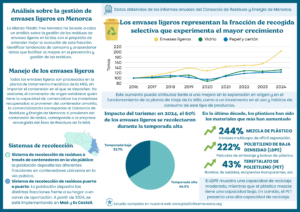
Tonnes of lightweight packaging collected have doubled since 2016
Of all selectively collected waste fractions, lightweight packaging has seen the greatest increase since 2016, surpassing glass and paper and cardboard. This rise can be explained both by improvements in source separation and in the operation of the Es Milà sorting plant, as well as by increased use and consumption of this type of product.
In 2024, six out of ten lightweight packages (66%) were collected during the high season
Data from 2024 show that Maó and Ciutadella account for 63% of the lightweight packaging collected in Menorca, in line with their demographic weight. The study also clearly highlights the influence of tourism, as 66% of lightweight packaging in 2024 was collected during the high season.
“These figures confirm that the tourism sector plays a key role in the use of lightweight packaging, but also in its reduction. For this reason, at Menorca Preservation we consider it essential to continue working collaboratively to move towards more responsible models that aim to reduce waste generation, minimise environmental impact and preserve the territory that makes Menorca a unique destination,” said Rebecca Morris, Director of Menorca Preservation.
A decade of change in packaging materials: plastics show the greatest growth
Another key finding of the study is the evolution of lightweight packaging materials consumed in Menorca over the past decade. Plastics have seen the greatest growth, particularly mixed plastics (+244%), LDPE (+222%) and PET (+43%). In contrast, HDPE is the only plastic to show a significant decrease (−45%).
Among non-plastic packaging, metal packaging (steel and aluminium) has decreased by 13%, while cartons (Tetra Pak-type packaging) have shown only very modest growth (+4%). These figures reflect a significant shift in consumption habits, with lightweight plastics representing an increasing share of overall packaging.
The importance of understanding plastic recyclability
The Plastic Free Menorca Alliance highlights that not all plastics have the same recycling potential, a key factor in moving towards more efficient waste management. The study explains that PET (polyethylene terephthalate), commonly used in beverage bottles, and HDPE (high-density polyethylene), used for items such as detergent containers, are among the most recyclable plastics.
LDPE (low-density polyethylene), found in plastic bags, and PP (polypropylene), used in items such as medicine packaging, have moderate recyclability. By contrast, PVC (used in toys and pipes), PS (food trays and protective packaging) and other plastics (category 7) are more difficult to recycle.
“Reducing the amount of lightweight packaging we use is the most important step towards managing waste sustainably. However, when we do use it, it is also important to know what material it is made from, as some can be recycled more easily and efficiently than others,” said Marta Pérez, study coordinator.
The effectiveness of the door-to-door system in Maó and Es Castell
The analysis also focuses on the impact of the door-to-door collection system implemented in Maó and Es Castell. The data show very positive results in terms of the separate collection of lightweight packaging: in 2024, collection of this fraction increased by 64% in Maó and 98% in Es Castell compared to the previous year, demonstrating the effectiveness of the system in improving source separation.
Differences in the management of lightweight packaging depending on its destination
Finally, the analysis also indicates significant differences in the management of lightweight packaging depending on its destination. Waste deposited in the yellow container is managed as a by-product (marketable and therefore capable of generating economic return) by the Island Council of Menorca. In contrast, lightweight packaging disposed of in the residual waste fraction is sent to the Es Milà mechanical treatment plant, where part of the recoverable materials is also reclaimed as a by-product by the Es Milà consortium.