The future of recreational fishing
The future of recreational fishing discussed in Menorca through science and participation
The Fòrum Illa de l’Aire brings together scientists, public authorities, the fishing sector and the wider community to share knowledge and promote a more participatory approach to marine resource management
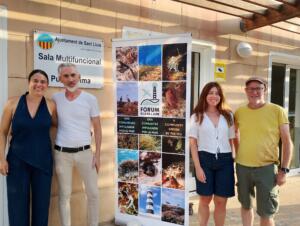
Yesterday, the Punta Prima Community Hall hosted the event “Recreational fishing in Menorca: where are we now and where are we heading?”, organised as part of the Fòrum Illa de l’Aire. The event brought together more than 35 participants interested in learning about recent trends in recreational fishing in Menorca, exchanging different perspectives on marine resource management and reflecting together on the challenges ahead.
Throughout the afternoon, researchers, public administration representatives and fisheries management specialists presented the results of a range of studies and experiences carried out both in Menorca and elsewhere in the Mediterranean.
Eva Marsinyach (IME-OBSAM) presented an overview of recreational fishing in Menorca between 2002 and 2022; Antoni Mira (Directorate-General for Fisheries, Balearic Government) explained the monitoring systems used in marine reserves and the catch reporting tools currently in place; Joan Moranta (Jaume Ferrer Research Station / Balearic Oceanographic Centre – IEO-CSIC) discussed the reserve effect on coastal fish species that are particularly vulnerable to fishing within the Illa de l’Aire Marine Reserve; while Eve Galimany and Marta Pujol-Baucells (ICATMAR / ICM-CSIC) shared Catalonia’s experience of recreational fisheries co-management.
Recreational fishing is one of the most significant user groups within the Marine Reserve and, at the same time, a highly diverse community. During the governance process launched in 2025, the Fòrum Illa de l’Aire identified the need to strengthen dialogue with this sector. The event was therefore designed to build trust between recreational fishers, scientists, public authorities and the wider community by creating a space to exchange knowledge, listen to different perspectives and work towards a more inclusive and participatory approach to marine resource management.
Following the presentations, participants took part in an open discussion where they shared questions, concerns and proposals regarding the future of recreational fishing in Menorca.
One of the topics that generated the greatest discussion was the need to strengthen surveillance and improve compliance with existing regulations, both in relation to recreational fishing and to other management measures within the Marine Reserve, such as the forthcoming speed limit for vessels.
Participants also highlighted the importance of making current regulations easier to access and understand, so that users are better informed and able to comply with them.
Scientific monitoring of the Marine Reserve also prompted an engaging discussion. Some participants shared the perception that certain iconic species, such as the dusky grouper, have not yet shown an obvious recovery. Researchers explained that, while this perception is understandable, scientific data show clear increases in both biomass and abundance for several fish species since the Marine Reserve was established. Regarding the so-called “reserve effect”—where fish move beyond the protected area into neighbouring fishing grounds—they noted that it is still too early to confirm this phenomenon in the Illa de l’Aire Marine Reserve, although it remains one of the key outcomes that ongoing monitoring aims to assess. They also emphasised that the rapid improvements already observed are consistent with the recovery typically seen in marine ecosystems once fishing pressure is removed, supporting the conclusion that these positive trends are a direct result of the protection provided by the Marine Reserve.
Another topic of interest concerned the interpretation of recreational fishing licence data. Participants discussed how it is possible to identify where fishers using the Marine Reserve come from and to what extent the number of licences issued reflects the actual number of recreational fishers in the Balearic Islands. Representatives from the Directorate-General for Fisheries explained that differences between Spain’s autonomous communities in licence fees and licensing requirements make it difficult to use licence numbers as an accurate indicator of the true number of recreational fishers in each region.
The experience presented by ICATMAR also attracted considerable interest. Discussions focused on how co-management bodies operate, how frequently meetings take place between public authorities, scientists and the fishing sector, and how ecological criteria—such as species’ breeding periods—can be incorporated into jointly agreed management measures.
“This event has been an important opportunity to engage with the recreational fishing sector, a highly diverse community with whom we want to strengthen dialogue and explore new ways of working together. Building trust, sharing knowledge and listening to different perspectives are essential if we are to move towards a more participatory approach to managing the Marine Reserve,” said Aina Blanco-Magadán, Project Coordinator.
“Scientific knowledge must provide the foundation for defining management measures for the Marine Reserve, helping to identify priorities such as strengthening surveillance. At Menorca Preservation, we will continue consolidating the Fòrum Illa de l’Aire as a governance platform that facilitates knowledge exchange, promotes the use of science in decision-making, and supports the monitoring of public policies to improve conservation outcomes,” added Clara Blasco, Programmes Director at Menorca Preservation.
The event concluded with a networking reception, giving participants the opportunity to continue exchanging ideas and reinforcing the Fòrum Illa de l’Aire’s aim of creating spaces where scientists, public authorities, the fishing sector and the wider community can work together to develop proposals for marine conservation.
Over the coming months, the Fòrum Illa de l’Aire will continue promoting participatory initiatives to strengthen the governance of the Marine Reserve and encourage management based on scientific knowledge and collaboration between all stakeholders. As a direct follow-up to this event, work will focus on strengthening collaboration with the recreational fishing sector and developing clear, practical communication materials tailored to its needs, based on dialogue and contributions from the sector itself.
The Fòrum Illa de l’Aire is an initiative led by Menorca Preservation in collaboration with the Marilles Foundation, with the support of Sant Lluís Town Council and the technical involvement of OBSAM-IME and GOB Menorca.