Is there plastic pollution along the Camí de Cavalls?
Camí de Cavalls 360º presents a study on plastic pollution along the Camí de Cavalls
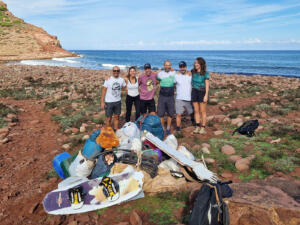
The study, commissioned by the company behind Camí de Cavalls 360º, concludes that litter is concentrated in coastal and urban areas unrelated to the trail itself, while the natural sections of the route show little or no plastic pollution.
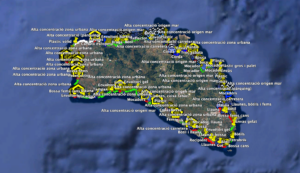
40 Nord Outdoor, the company behind Camí de Cavalls 360º, has carried out a Study on Plastic Pollution along the Camí de Cavalls with the aim of gathering its own field data to better understand where litter accumulates, what types of waste are found, and the factors that explain its distribution along the route.
The study was carried out with the technical support of the Plastic Free Menorca Alliance and forms part of the Camí de Cavalls 360º Conservation Project, an initiative through which 40 Nord Outdoor and its participants invest resources and undertake direct conservation actions to maintain, improve and protect the Camí de Cavalls and its surrounding environment.
The study reaches a clear conclusion: plastic pollution along the Camí de Cavalls cannot be explained simply by the number of people using the route. Instead, the most significant factors are the type of landscape (woodland, agricultural land, coastal areas, urban areas or roads) and how each space is used.
A field study covering the entire 185-kilometre route
Fieldwork was carried out between 15 and 31 July 2025 by a team of four people. During this period, the entire 185 km Camí de Cavalls was surveyed, with every item of litter photographed and geolocated. The information was then digitised, organised and analysed until January 2026.
For the purposes of the study, the route was divided into 32 survey sections and 97 analytical sub-sections, classified according to landscape type, visitor profile, visitor numbers and likely sources of litter.
The study also notes that, in urban areas, along roads and at certain coastal locations, extremely high concentrations of litter and the presence of microplastics sometimes made it impossible to record every item accurately. By contrast, the natural sections of the trail, where litter was much less concentrated, could be surveyed in a highly detailed and reliable manner.
The full dataset and analysis are available at camidecavalls360.com.
The main source of litter: external inputs rather than the trail itself
The study identifies a very clear pattern: large parts of the Camí de Cavalls have little or no litter, while a limited number of specific locations show very high concentrations.
The main litter hotspots are:
- Coastal inlets, coves, pebble beaches and rocky shores where marine litter accumulates.
- Car parks and access points.
- Roadside sections.
- Urban areas.
- Busy beaches.
In these environments, litter rarely originates from trail users themselves. Instead, it mainly comes from external sources, including urban activity, recreational use of public spaces, roads, access points and marine currents.
Along the coastline, the study highlights that the areas with the highest concentrations are almost always shaped by marine dynamics. Even where there are relatively few visitors, the sea acts as both a transport mechanism and an accumulation point for floating litter.
By contrast, the sections most closely associated with the typical hiking and cycling experience — woodland, agricultural landscapes and rural areas — generally show little or no litter. The study estimates that, across the 116.9 km of the route that do not pass through urban areas, roads, beaches, coves or coastal inlets, more than 99% of the trail is free from litter.
Visitor profile has a greater influence than visitor numbers
One of the study’s most significant findings is that the type of visitor has a greater influence on litter levels than the number of visitors.
Sections mainly used by hikers and cyclists consistently showed little or no litter, even where visitor numbers were moderate or high. According to the study, the amount of litter directly generated by these users is minimal and largely anecdotal.
The highest concentrations, by contrast, are associated with beaches, urban areas, roads, access points and places where people spend longer periods of time. These locations accumulate litter generated through intensive use, waste arriving from outside the trail, and debris that is often difficult to quantify.
The most significant litter hotspots therefore occur where factors unrelated to hiking or cycling converge: the sea, roads, access points, car parks, urban areas and busy beaches.
A tool for more effective conservation
Joan Febrer, Director of 40 Nord Outdoor, explains the reasoning behind the initiative: “We launched this study to move beyond perception and towards evidence, enabling us to better target our conservation efforts. This allows us to develop more realistic and effective actions for awareness-raising, management, clean-up operations and conservation, focusing on coastal accumulation points, access areas, car parks, roadsides, urban environments and heavily visited beaches.”
Part of the Camí de Cavalls 360º Conservation Project
This study forms part of the Camí de Cavalls 360º Conservation Project, through which 40 Nord Outdoor aims not only to ensure its activities respect the natural environment, but also to make a direct contribution to its protection.
The Conservation Project supports a range of initiatives focused on maintaining and improving the Camí de Cavalls, other public footpaths across Menorca, and the surrounding landscapes.
Among these initiatives is 0º Plastic, which aims to reduce the use of single-use plastics, raise awareness among participants, and organise litter collection activities along the Camí de Cavalls and its surrounding environment. To date, more than 600 kg of plastic and other waste has been removed.
About 40 Nord Outdoor and Camí de Cavalls 360º
40 Nord Outdoor S.L. is the company behind Camí de Cavalls 360º, an experience that since 2012 has enabled visitors to complete the Camí de Cavalls in stages throughout the year, whether on foot, trail running or by mountain bike.
Collaboration with the Plastic Free Menorca Alliance
The study was carried out with the support of the Plastic Free Menorca Alliance, an initiative led by Menorca Preservation that brings together local organisations working to reduce plastic pollution across the island through awareness-raising, reuse initiatives, litter collection and the promotion of environmentally responsible practices.