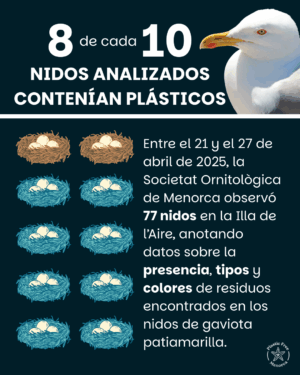
“82% of yellow-legged gull nests on Illa de l’Aire contain plastics”
Plastic Free Menorca Alliance and the Menorca Ornithological Society collaborate to study, for the first time, the presence of plastics in nests on Illa de l’Aire
Plastic Free Menorca Alliance has received a grant from the Ministry of Agriculture, Fisheries and Natural Environment of the Government of the Balearic Islands to launch the “Plastic Observatory”, an initiative aimed at reducing plastic use through the objective analysis of plastic management, its impacts and related regulations, as well as the dissemination of results to society.
The first indicator, now available on the Alliance’s website, analyses for the first time the presence of plastic waste in the nests of the yellow-legged gull (Larus michahellis) on Illa de l’Aire.
Data collection was carried out with the collaboration of the Menorca Ornithological Society (SOM). During its ringing campaign in April this year, the organisation voluntarily observed and recorded all necessary field data for the study.
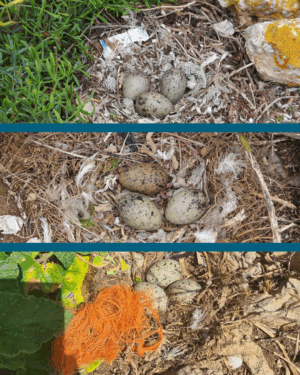
A total of 77 nests were analysed between 21 and 27 April 2025. The field data recorded included five types of information: nest diameter, presence of eggs and/or chicks, presence of waste—differentiating between filaments, rubber/polystyrene, hard plastics, film plastics and other materials—and the colour of each item identified.
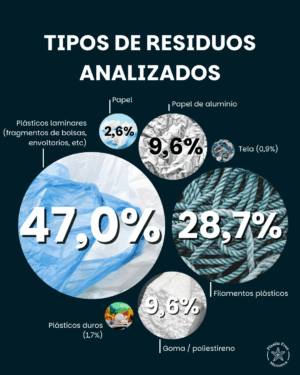
The results, analysed by Plastic Free Menorca Alliance with the collaboration of Raül Escandell from the Menorca Ornithological Society, reveal that 8 out of 10 nests (82%) contain waste, mostly plastic materials. Film plastics are the most frequent type (47%), followed by plastic filaments (28.7%) and rubber/polystyrene (9.6%). Fragments of aluminium foil, paper, hard plastics and textile remains were also identified. The most common colour is white (62.9%), mainly associated with pieces of bags and other film plastics.
“It is essential to start having real, objective data showing the local impact of plastic pollution. Only then can we properly guide the actions needed to tackle a form of pollution that is continuously and increasingly affecting the island’s natural environment—and the people who live here,” says Marta Pérez, coordinator of the Plastic Free Menorca Alliance. She adds: “The impact of plastics goes far beyond the landscape: it is altering ecosystems and directly affecting Menorca’s biodiversity. The gulls are showing us that pollution is present even in seemingly remote areas such as Illa de l’Aire.”
Comparison with data from the Canary Islands
The report includes a comparison with a study carried out in Biosphere Reserves in the Canary Islands (2020–2021), based on abandoned nests in Lanzarote and Fuerteventura. In those islands, similarly, 8 out of 10 nests contained waste, although the composition suggested a land-based origin, more closely linked to immediate consumption items such as food packaging and personal hygiene products.
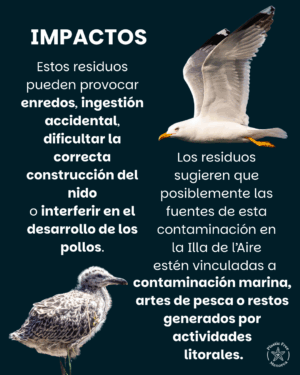
In contrast, in Menorca—where the study was conducted on Illa de l’Aire, an islet separated from the main island—the overwhelming predominance of plastics (87% of identified items) suggests more diffuse sources, possibly linked to marine pollution, fishing gear or waste generated by coastal activities.
A serious risk for island fauna
The presence of plastics in nests can cause entanglement, accidental ingestion, hinder proper nest construction or interfere with chick development.
Regarding whether this data could indicate if gulls also ingest plastics, Raül Escandell explains:
“Gulls are selective animals when it comes to feeding and do not usually pick up waste unless it retains a food scent. Even so, to have more rigorous data, it would be interesting to analyse the presence of plastics in pellets in future campaigns. Some bird species expel indigestible parts (feathers, hair, bones, claws and teeth) in compact balls known as pellets, which could provide key information on this aspect.”
Call to action
Plastic Free Menorca Alliance warns that these findings are a clear sign of the need to intensify prevention and waste reduction measures, especially in sensitive natural environments. Continued monitoring will make it possible to analyse the evolution of the problem and guide public policies and environmental initiatives.